
How Parkinson's Boxing Actually Works: A Plain-English Guide
What Parkinson's boxing is, why it works, what a class looks like, and how to know if it's right for you or someone you love. Written by the coaches running the program in Ballard, Seattle.
May 1, 2026 · By BBBC Coaching Staff
If you or someone you love has been diagnosed with Parkinson's disease, you've probably heard about Parkinson's boxing. Maybe a neurologist mentioned it. Maybe a friend in a support group brought it up. Maybe a news article showed up in your feed.
This post is a plain-English explanation of what it actually is, why it works, and what to expect. We coach Parkinson's boxing classes at Ballard Barbell and Boxing Club, and we've watched dozens of people improve their lives through it. Some of what's in this guide is general; some is specific to how we run our program. Both are useful.
What it is, in one paragraph
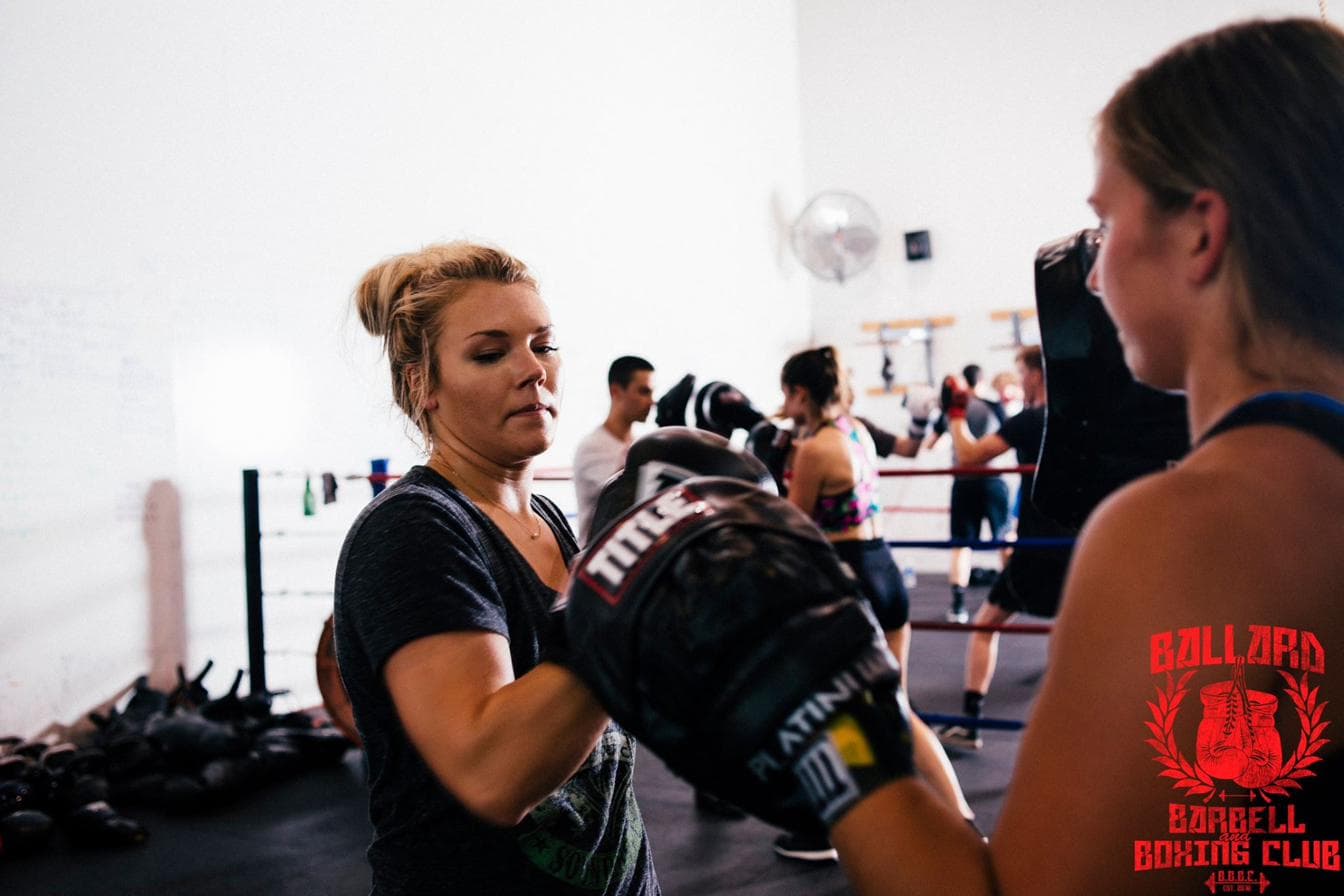
Parkinson's boxing is a non-contact, coach-led exercise class designed specifically for people living with Parkinson's disease. It uses the movements and drills of boxing training (footwork, punching combinations on heavy bags and focus mitts, agility work, voice projection drills) to target the physical and cognitive symptoms of Parkinson's. Nobody hits anyone. There's no sparring. There's no risk of head impact. The "boxing" part is the training method, not the sport.
Why boxing, specifically
This is the question every family asks first, and it's a good one. There are a lot of forms of exercise that help with Parkinson's. Why boxing?
Three reasons, in order of importance.
It trains the things Parkinson's takes away. Parkinson's progressively affects balance, posture, gait, fine motor control, range of motion, vocal projection, reaction time, and confidence in movement. Boxing training, almost by accident, targets every single one of those. Throwing a punch with proper mechanics requires balance, rotational power, hip mobility, shoulder mobility, and timing. Maintaining a boxing stance trains posture. Footwork drills train gait and agility. Combination work trains memory and reaction time. The "Yes!" call-outs that coaches use train voice projection.
It's intense enough to drive neuroplastic changes. Research over the past fifteen years has converged on the finding that intense, complex, novel exercise is what produces meaningful neurological benefits for people with Parkinson's, beyond what gentle movement provides. Boxing checks all three boxes. It is genuinely intense (we modify intensity to your day, but the underlying methodology is high-effort), it is complex (multi-step combinations under cognitive load), and it is novel (the drills change constantly, forcing your brain to adapt).
It is fun and social. This sounds soft compared to the first two reasons. It is the most important reason in practice. The single best predictor of whether someone with Parkinson's maintains their exercise routine over years is whether they actually enjoy it. Parkinson's boxing classes consistently have higher long-term retention than other exercise modalities for this population because the experience is engaging, the community is real, and the wins are visible.
What a class actually looks like
A typical sixty-minute Parkinson's boxing class at BBBC has five parts.
Arrival and check-in. About five minutes. Members arrive five to ten minutes early. The coach greets everyone, asks how the morning is going, checks in on anyone managing a flare or a new symptom that day, and helps with wraps and gloves.
Warm-up and mobility. About ten minutes. Gentle dynamic movement. Reaching, twisting, marching in place, shoulder circles, ankle mobility. The goal is to prepare the body, improve posture, and raise the heart rate. Nothing here is more demanding than what a typical person does over the course of a morning.
Skill practice. About twenty minutes. This is the boxing-specific portion. Members rotate through stations: focus mitts with a coach, heavy bag work, footwork ladder drills, balance work. Each station has a coach or assistant directly supervising. Combinations are called out, and members respond with the punches. Voice projection drills are built in, often by having members count their combinations out loud.
Strength and conditioning. About fifteen minutes. Safe, progressive resistance work. Sit-to-stand exercises, rows with light bands, overhead presses with light dumbbells, step-ups, core work. Everything is scalable. A more able-bodied member might do a full set of bodyweight squats. Someone managing balance challenges might do supported sit-to-stands from a chair. Both are doing the same exercise.
Cool-down. About ten minutes. Stretching, breathing exercises, and a few minutes of casual conversation. People often stay after class to chat, which is part of the point.
Who it's for
The program works well for a wide range of people living with Parkinson's. We have members in their fifties who run marathons in their off time. We have members in their eighties who use walkers and rely on the supported variations of every exercise. Both make progress. Both look forward to class.
The honest criteria for whether it's right for you or someone you love:
- A confirmed diagnosis of Parkinson's disease at any stage.
- Doctor clearance to participate in exercise (this is the only formal requirement we ask for, and most neurologists strongly support it).
- Willingness to show up consistently, ideally two to three times per week.
If you're in earlier stages of Parkinson's, the program is preventive: building strength, balance, and confidence before symptoms progress meaningfully limits your movement. If you're in more advanced stages, the program is adaptive: working within your current ability to maintain what you have and slow further decline. Both are valid, and both produce real benefits.
We also welcome caregivers who want to observe or participate alongside their person. Many do. Some end up training in our regular group classes after seeing what the gym looks like up close.
What to expect in your first month
Almost everyone reports the same pattern in their first four to six weeks.
Week 1. Awkwardness. You'll be self-conscious about your form, unsure of the gym layout, possibly tired in ways you weren't expecting. This is universal and it passes.
Week 2. Recognition. You'll start recognizing the coaches and other members by name. The combinations stop feeling completely random. You'll have a small moment of "oh, I'm getting this."
Week 3-4. Real progress. Your balance feels different on certain days. Your voice has more projection. You're more confident moving around your home. Family members start to notice something they can't quite name.
Month 2. This is when most members tell us, unprompted, that they look forward to class. Not "I'm glad I went," not "I should keep going." They look forward to it. The combination of community, capability, and identity (you are now a person who boxes) becomes self-sustaining.
We can't guarantee any specific outcome. Parkinson's is a progressive disease and trajectories vary. What we can say is that consistent participation in the program is one of the most evidence-supported things you can do to maintain your physical function and quality of life.
How to know if it's right for you
There's only one good way to know: come try a class. The first one is free, and you're under no obligation to commit to anything.
What we recommend before that first class:
- Talk to your doctor or neurologist. Get clearance for exercise and ask if they have any specific guidance.
- Have a real conversation with your support person (spouse, adult child, close friend). Tell them you're thinking about trying it. The buy-in helps you show up the second time.
- Email or call us. We'll answer questions, talk through your specific situation, and recommend a class to start with. No sales pressure. If we think the program isn't right for someone, we say so.
The Parkinson's program meets Mondays and Thursdays at 10:30 AM. If those times don't work, contact us and we'll explore options. We're actively expanding the program as demand grows.
You can reach us at info@ballardboxing.com or (206) 384-8026. The first class is always free. We'd love to meet you.
Your first class
is always free.
Show up, train, decide for yourself. No commitment, no follow-up sales pressure.
Reserve Your Free Class